
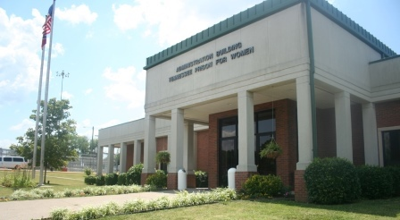


Tennessee Prison for Women
A Tennessee Department of Correction guard was fired in May after admitting to having sexual contact with an inmate at the Tennessee Prison for Women. In follow-up interviews, staffers asked the inmate if she enjoyed it.
In a dismissal letter written to Daniel Sievers on May 26, the department gave a vague description of the reasons for his termination: “You have been dismissed from employment based on the Office of Investigations and Compliance (OIC) investigation for alleged acts of inappropriate touching involving an inmate, kissing an inmate and corresponding love letters.”
While the letter doesn’t go into detail about the alleged sexual acts, it says, “Due to the seriousness of the situation, you will not be eligible for rehire with the State of Tennessee.”
But a letter written to the Scene by a woman Sievers had sex with at the prison — the Scene does not print the names of victims of sexual assault — paints a different picture than the letter of dismissal.
She says within the first month Sievers started working at the women’s prison, he brought her a Sprite bottle that contained alcohol rather than soda. Later that evening — after she had become extremely intoxicated — the inmate says he returned to her cell with a condom and “convinced me into having sex with him.”
“I’m guessing he had the evening planned beforehand,” she writes.
The letter goes on to detail that Sievers wrote the woman letters telling her he loved her and that he had sex with her at least one other time while she was under the influence of an illegal substance. The woman did not indicate where she got drugs while in prison.
When investigators first interviewed the woman, she gave them a letter from Sievers, but did not reveal that the two had any sexual contact. In a subsequent interview, she says she told them about having sex with Sievers after investigators told her he had had sex with five other women in the facility.
“It was at that time that I realized I was the victim of a sexual predator,” the woman writes.
The woman says that during another follow-up interview, investigators asked whether she had an orgasm during sexual contact with Sievers.
“When you are victimized by a man, the last thing you want to do is talk about it to five men,” she writes. “I believe this could have been prevented. No male officer should have had the opportunity to enter my cell and engage in any sexual acts.”
The woman has since been transferred to another facility.
Jesse Lerner-Kinglake, communications director for Just Detention, a Los Angeles-based organization that advocates for the end of prison rape, says standards under the Prison Rape Elimination Act, a federal law passed in 2003, explicitly prohibit any sexual contact between officers and inmates. Because the power balance is so unequal between an officer and a prisoner, he says, “there can be no such thing as consensual sex behind bars.”
“The other piece, broadly and generally nationwide, is that reporting sexual abuse is difficult in any setting — whether behind bars or out in the world,” Lerner-Kinglake adds. “There’s a stigma attached to it. Historically, investigators have not been properly trained in how to conduct these investigations.”
Lerner-Kinglake calls the investigator’s question about the inmate’s arousal “completely despicable.”
“That’s exactly the kind of behavior of an investigator that makes people say, ‘No, of course I’m not going to come forward,’ ” he says.
Sievers, who was hired at the women’s prison in October 2015, had worked at another TDOC prison, Charles Bass Correctional Facility in Nashville, for less than a year in 2013. He quit to attend The Art Institute of Tennessee, according to his personnel file.
Sievers received one write-up while working for TDOC: In January, he failed to keep watch on a visitor who was suspected of bringing contraband into the facility.
TDOC did not respond to any questions about the events, but provided Sievers’ personnel file and a statement.
“The safety of our staff and offenders is our priority,” TDOC’s Alison Rangaard writes in an email to the Scene. “Inappropriate contact between employees and offenders will not be tolerated by the Department. Such situations are investigated by our Office of Investigations and Compliance and referred to the district attorney for possible prosecution.”
The Davidson County District Attorney’s Office confirms it received a complaint about Sievers, but Ken Whitehouse, a department spokesperson, could not elaborate on any action. A review of Davidson County criminal court records shows no charges have been filed and no arrests have been made.



Post a comment as anonymous
Report
Watch this discussion.
(0) comments
Welcome to the discussion.
Log In
Welcome to the discussion.
Keep it clean. Please avoid obscene, vulgar, lewd, racist or otherwise abusive language. Comments featuring hate speech or threatening or violent content will not be tolerated.
PLEASE TURN OFF YOUR CAPS LOCK.
Be truthful. Don't knowingly lie or mislead.
Be proactive. Use the “report” link on any comment that violates our comment policy.
Share with us. We'd love to hear your feedback.