

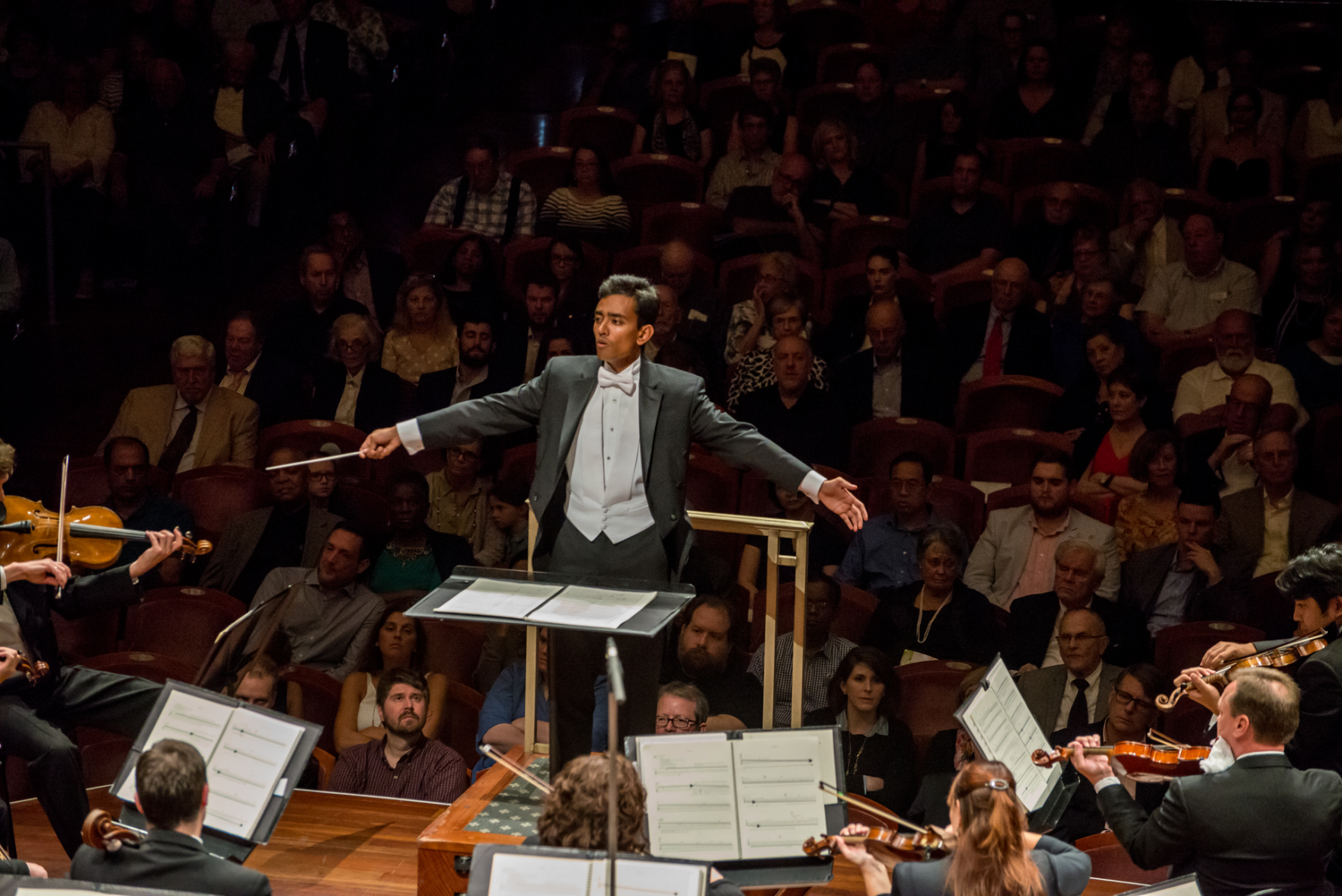
Vinay Parameswaran
The Nashville Symphony Orchestra’s concert Friday at the Schermerhorn was supposed to be about the future. It was supposed to be about youth — the program’s star attractions were all in their 20s. But the concert’s most memorable moment occurred when a youthful guest artist performed music written by a 97-year-old.
Following his bracing rendition of Grieg’s Piano Concerto in A minor, 22-year-old pianist Conrad Tao turned to the music of Elliott Carter for an encore. One of music history’s great methuselahs, Carter was just a month shy of his 104th birthday when he died in 2012. In life, he’d been known for composing works of uncompromising rhythmic complexity. Suffice it to say that his music was often easier to admire than to love.
Yet the audience that filled the Schermerhorn on Oct. 7 seemed genuinely dazzled by Carter’s score. As Tao’s fleet fingers raced through Caténaires, a dissonant perpetual-motion piece that Carter composed at age 97, the audience listened with breathless excitement. In the end, they roared their approval, giving Tao a sustained ovation. I’ve reviewed concerts for decades, and this was the first time I heard Carter’s fiendishly difficult, cerebral music played as an encore. Hopefully it won’t be the last.
Carter’s piece wasn’t the most demanding work on the program. That distinction belonged to the opening piece, Tumblebird Contrails, written in 2014 by the NSO’s 24-year-old Composer Lab and Workshop Fellow, Gabriella Smith. A native of Northern California, Smith found inspiration for her music while watching a pair of ravens swooping over the Pacific Ocean. Her intent was to capture the hallucinatory power of the waves and the ecstasy of the birds. She succeeded magnificently.
Smith’s music was filled with long, sustained tones that moved gradually but inexorably, like sand shifting in the surf. The glistening quality of her strings writing readily called to mind the dapple of sunlight on the waves. Chirping wind instruments suggested the presence of birds. This complex, unfamiliar music might have intimidated an audience that wasn’t properly prepared. But Smith’s lucid pre-concert remarks put the audience in the right frame of mind, and after listening intently, they gave Smith and the orchestra a much-deserved ovation.
Tao followed with the aforementioned Grieg concerto. This is one of those works of Romantic duality, a virtuoso showpiece that also functions as an extended, heartfelt song without words. In his performance, Tao emphasized the concerto’s showy side, playing with blistering speed while indulging in an orgy of octaves.
Yet there was more to Tao’s playing than mere razzle-dazzle. He was an imaginative tonal colorist who used the piano’s sustain pedal to create a wash of prismatic overtones. And he made the finale his own, turning the movement’s familiar Norwe-gian rhythm into an off-kilter dance. The NSO’s associate conductor, Vinay Parameswaran, provided Tao with colorful, flexible accompaniment.
The 29-year-old Parameswaran is familiar to Nashville Symphony audiences, having spent the past couple of years conducting pops and family concerts. This time, he was making his debut leading a classical series concert, and he made a strong impression.
I was especially taken with his terrific reading of Prokofiev’s bustling Symphony No. 5, which was composed at the height of World War II. Conducting from memory, Parameswaran led a performance that was remarkable both for its polish and power. There was plenty of nuance in this account, which seemingly probed every emotion — from giddiness and pensiveness to wildness and sarcasm. The performance earned a resounding ovation for the orchestra, and no doubt assured Parameswaran his place on future classical series programs.
Email arts@nashvillescene.com



