
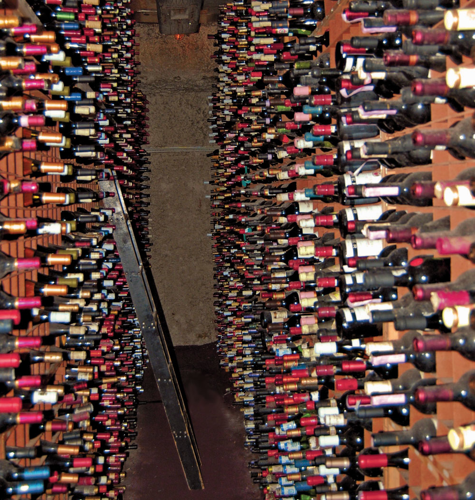
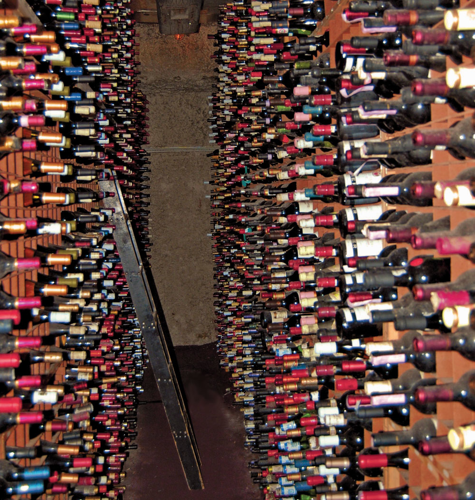

Bern’s Steakhouse in Tampa has a 600,000-bottle cellar — good luck navigating it without a sommelier.
When I tell people I am a sommelier, I am usually met with a blank stare or misplaced awe. The stare I blame on the fact that despite this era of peak food fetishism, a lot of people still have no idea what that foreign word means. The awe I attribute to the movie Somm, which seems to have left many with the mistaken idea that all sommeliers are savants who can sniff a Savennières from the other room.

More evidence of popular confusion bubbled up recently when an old friend, upon hearing that I hadn’t done any formal training to become a sommelier, gently told me she thought schooling was required, which came across as a gentle suggestion that maybe I was full of shit. The fact that there is no real consensus on exactly what we are talking about only makes things worse. Is a sommelier the holder of some kind of degree, or certification, or job? If it is a degree or certification and a job, can a person hold one without the other? The short answer is that it is both a certification and a job. The longer answer can’t possibly fit into the space of one column, so we’ll do it in two parts.
First, the job. My dictionary states that a sommelier is simply a waiter who serves wine, which implies that every Applebee’s server who has plunked down a spotted glass of plonk is a sommelier. That is far too loose, but there is value in a definition that peels away the common image of the haughty sommelier, whether one pictures the imperious French archetype nosing his tastevin or his tattooed and bearded 21st-century counterpart. The job, at its heart, is one of service.
Cities with more developed dining scenes can support waiters who flit from table to table only serving wine, imparting their specialized knowledge and sharing in the gratuities. In Nashville, the job tends to be managerial and fraught with the duties that can make restaurant manager jobs so unappealing: Closing the restaurant, handling guest complaints and ceaseless staff drama all come with the territory, much to the dismay of the sommelier who would rather just taste wine and tinker with his list all day. It is possible to perform the job while avoiding the managerial mantle (and for many former servers, the managerial pay cut), but this often involves continuing to hustle around the dining room waiting tables, occasionally getting yanked away when your expertise is needed.
Both of these scenarios blast holes in the myth that this job, which revolves around a pleasurable elixir, is nothing but dreamy. Once, after an acquaintance referred to me as having the “best job in the world,” I thought about how the previous day I had spent four hours in Microsoft Excel and three minutes chiseling petrified ketchup off of a table leg. I was like, News to me!
Perhaps the meatiest and most satisfying portion of the job comes before the first guest crosses the threshold: making the wine list. Here a sommelier can create something in her own image, expressing her creativity and point-of-view, as long as they jibe with the spirit and financial constraints of the establishment. Some places seek to wow diners with a bounty of as many vintages of as many wines as storage space will allow. Others take a focused approach and offer a compact and thoughtful list on which every wine plays a vital role. These lists seldom tolerate any laggard wines.
Wines come and go, vintners retire, and distributors run dry, so wine lists require constant tuning and maintenance; they expand and contract and are never really “finished.” For the sommelier committed to catching a sneaky vintage change before a disappointed guest does, there is always something to check, and too much attention to detail is never enough: Chateauneuf is not Châteauneuf at all.
List maintenance also means tasting: sampling the wares of different purveyors to determine what comes next. What will take the place of that tightly allocated Spätlese riesling until it comes back next year? Can a Croatian plavac mali really fill the shoes of a zinfandel? Although being strafed by text messages from eager distributors can get tiresome, tasting their breadth of wines is nice — it just happens to be a smaller part of the job than commonly imagined. I will risk mockery and mock pity to convey this unpopular truth: Drinking wine after wine after wine may be a party, but evaluating them is real work.
Once a restaurant’s doors open for service, the sommelier’s duty is to act as guide to seasoned drinkers who don’t see their favorite producer on the list, as well as to novices who hardly recognize one word on it. Husk Nashville sommelier Nicolette Anctil presides over a list with an extra obstacle: It is organized by soil type, a decision that fits the Husk ethos but can frustrate those who expect to see all of their pinot noir choices on one page.
In any establishment, familiarity with the list is required of a good sommelier, as are knowledge and skills far beyond it: If a guest is crestfallen that the list has no Valtellina, how will you know to offer him another light, floral red if you don’t know the wines of that cool Italian region? How do you placate an impatient guest agitated by the absence of Caymus, or perturbed by a red wine that, at the proper temperature, feels too cold? This is where a sommelier’s mind must quickly access the raw data stacked therein. It’s where authority must be expressed without pedantry, egos must be checked, and parched wells of patience must be tapped. It’s tough to nail every time.
“It’s about tearing down a wall for the guest,” Anctil says, a task that she asserts, with a laugh, is not made easier by the fact that she looks so young. But once the guest realizes they are in the hands of a serious professional, the barrier can begin to crumble.
“That’s when they can say to me, ‘I don’t know how to read this,’ ” Anctil explains of the Husk list. “And that’s when I can say, ‘I am here to help you.’ ”
Email arts@nashvillescene.com



Post a comment as anonymous
Report
Watch this discussion.
(0) comments
Welcome to the discussion.
Log In
Welcome to the discussion.
Keep it clean. Please avoid obscene, vulgar, lewd, racist or otherwise abusive language. Comments featuring hate speech or threatening or violent content will not be tolerated.
PLEASE TURN OFF YOUR CAPS LOCK.
Be truthful. Don't knowingly lie or mislead.
Be proactive. Use the “report” link on any comment that violates our comment policy.
Share with us. We'd love to hear your feedback.