
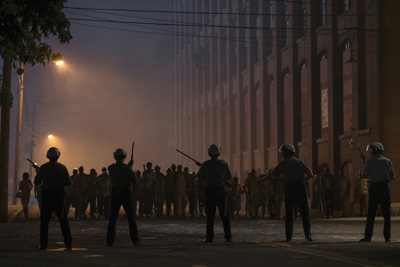


There’s a detail tucked away inside the intense and deeply felt Detroit that sticks in the back of your mind. A father has been told that his son is dead, and as he talks to the rest of his family, we see that he clutches several pictures of the boy, each from different points in his life, each in frames. Nothing too ornate, just the kind of frames you might use to preserve your own memories. The moment doesn’t draw too much attention to itself, but it resonates.
To take as momentous an event as the 1967 Detroit riots and try to make a traditional, representational historical drama would be an exercise in unfulfillable expectations. So instead, director Kathryn Bigelow and writer Mark Boal take a different approach, one that is like that father’s instinctive attempt to use those pictures to get at the meaning of his son’s life. We have primary source broadcasts, old news footage, still photographs, dramatized vignettes and several narrative strains that wind together during the third night of the riots. And from these disparate points, we assemble the bigger picture.
The central hour of the film focuses on events that occurred at the Algiers Motel, wherein three young black men were murdered and several other men and women were terrorized and tortured at the hands of renegade law enforcement officials. Bigelow has always been a critic of toxic cultures that are allowed to proliferate within state power, as seen in 1990’s Blue Steel and 1995’s Strange Days. Her mainstream breakthrough, 2008’s The Hurt Locker, and its follow-up, 2012’s Zero Dark Thirty, dug deep within military organizations on the battlefield and in the halls of power, and with Detroit, she has found a space in which to seek historical truth as well as one that illustrates the tragic ways humanity responds to unimaginable horror. Survivor’s guilt and post-traumatic stress disorder intermingle in the aftermath of the Algiers.
Detroit is not a film in which the police are racist caricatures. Instead, we are shown how tribalism can allow racism, violence, the weaponizing of religion and dehumanizing characteristics to take hold and flourish. A dismissive viewer might think the phraseology we’ve heard on countless YouTube videos and Facebook streams was included in the film as an anachronistic means of jolting audiences, but the opposite is true: In 50 years, the relationships between law enforcement and the communities they police have fallen back on the most brutal shorthand. If anything, Detroit illustrates how racists perceive reality as a false set of equations that somehow always justify the racist’s paranoid fantasies. The film acknowledges that racism is a tragic flaw, but it in no way excuses it — it knows that racism is a sign of weakness.
Detroit has been shot with a sure hand, and Bigelow never resorts to cheap shocks or the disorienting “shaky cam” effect that plagues many of her peers’ attempts at cinematic immediacy. If a series of escalating hassles is the American Way, then Bigelow and Boal’s approach to the material yields devastating results. The rough edges of the various characters (some fictionalized, many real) collide with one another like tectonic plates, often maintaining an uneasy balance, sometimes exploding outward, another extended metaphor that fits the way the film unfolds.
Star John Boyega (Star Wars: The Force Awakens) has, with this film, followed the path of Mark Hamill and gone from genial space opera to making his own The Big Red One. Anthony Mackie, who worked with Bigelow before on The Hurt Locker, here gives an incredible performance as a veteran dehumanized at every step of the way by a distrustful, calcified system.
After the physical violence, after a wrenching miscarriage of justice, the film alters its perspective, delving into the long-term situations of lives derailed by trauma. It feels like Bigelow is aiming for some kind of American exorcism here, a means of addressing directly the horrors that have been done and that continue to be done by systems of power that allow malign elements enough space to metastasize and wield illegitimate power. I thank her for trying. I hope it helps.
The film is exceptional and uncompromising, with the slightest leavening of hope. If we have another 50 years, let’s hope that America can unmake its acceptance of corruption, racism and dehumanization. Let’s hope.
Email arts@nashvillescene.com



Post a comment as anonymous
Report
Watch this discussion.
(0) comments
Welcome to the discussion.
Log In
Welcome to the discussion.
Keep it clean. Please avoid obscene, vulgar, lewd, racist or otherwise abusive language. Comments featuring hate speech or threatening or violent content will not be tolerated.
PLEASE TURN OFF YOUR CAPS LOCK.
Be truthful. Don't knowingly lie or mislead.
Be proactive. Use the “report” link on any comment that violates our comment policy.
Share with us. We'd love to hear your feedback.