
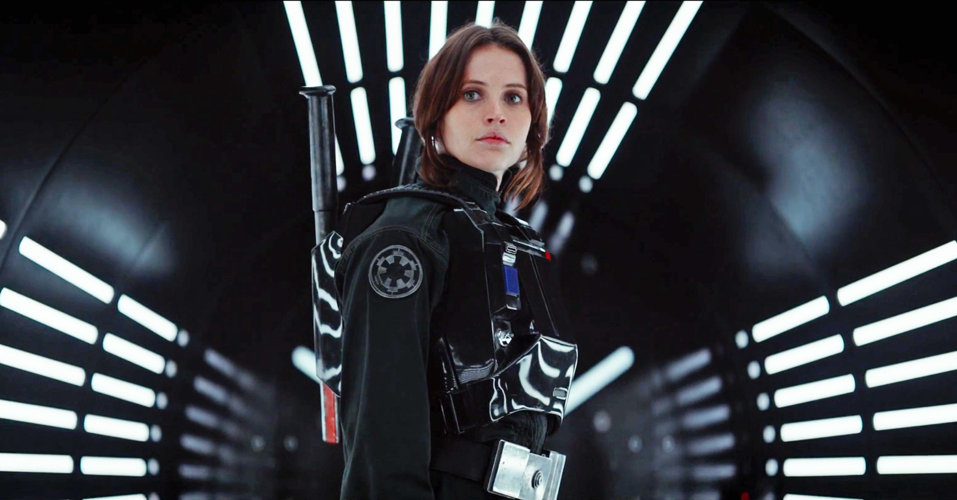
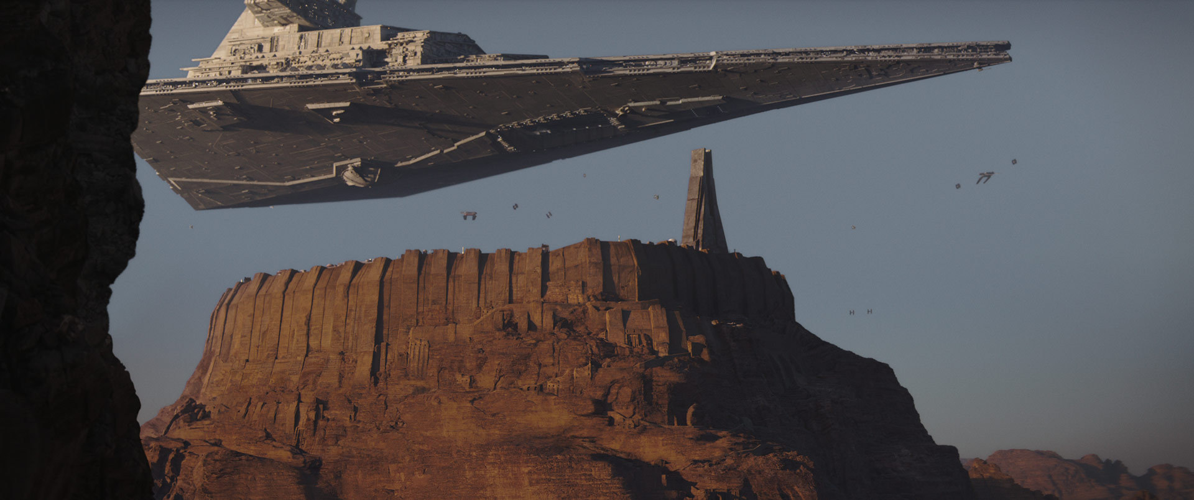


Beginning without a customary narrative crawl or the traditional John Williams fanfare, Rogue One hits the ground roaring, an exquisite dance of spaceship, planet, space and sky that feels weird at first due to the absence of those two traditional elements. But it’s a strange and angular film, and at its best when it’s letting its story careen throughout the galaxy, bringing into play secret information, a network of defectors, family intrigue and shady business involving a lot of murder.
The main problem with Rogue One is, oddly enough, the same problem that plagued this fall’s neo-Western Hell or High Water. The visuals, sense of place and direction are so strong that the dialogue seems overwrought and piled-up just by being there. Stripping the words down, eliminating the kind of screenwriting that never allows anything to go unsaid, would have served both films better. As it is, one wishes that the assorted studio executives would have looked at the film as it came together and thought “less” instead of “more.” There’s no extant information about what was redone in the film following an intensive period of reshoots in early 2016, but there are moments that clang in opposition to the film that surrounds them.
This is easily the most visually accomplished of any Star Wars film. Gareth Edwards (Godzilla ’14, Monsters) has always been good at graceful, deliberate frames that can express vastness and complexity without slipping into the overwhelming Where’s Waldo-isms of the prequels or the opportune vistas of the original trilogy. His sensibility is cinematic, and he gets across the grandeur of space unfussily, keeping space battles and ground clashes in balance. There’s no CG overkill, and Edwards depicts each environment with little details that indicate a great deal of thought and effort. The planet Jedha (or as I like to call it, Planet Jerusalem) is given about as much explanatory dialogue as any planet in these films are, but simply through the way the camera explores and reveals its cities, deserts and strongholds, you feel underneath your skin the unspoken histories of this place.
Which makes it a drag to note that Michael Giacchino’s score is remarkably unmemorable. The few instances where it echoes some of John Williams’ established themes makes certain moments pop in the viewer’s subconscious, but otherwise it all is subsumed by the kinesis of the images or the endearing sounds of blasters and engines and lightsabers and such.
Riz Ahmed, who was heartbreakingly good in Nightcrawler as the personification of trying to get over while not being a piece-of-shit human being, brings that same endearing moral complexity to his character Bodhi Rook, an Imperial defector with some important information. I can imagine some folks calling him a coward, which is overly judgy and unfair. Not everyone is comfortable dealing out death via laser, and Bodhi carries on even after a run-in with a brain squid that would have anyone questioning their ideologies. He is so unlike any other main character that we’ve encountered in a Star Wars film before, and it’s a relief that we can expand beyond basic Joseph Campbell archetypes herein.
Allow me also to praise K-2SO, the reprogrammed Imperial droid that serves as pilot, senior pragmatist and deadpan comic relief. Much as he did as the rooster Heihei in Moana, Alan Tudyk finds a way to bring a surprising amount of character to a nontraditional performance. In a way, he has the trickiest part to play, with some lines that dance on the edge of being just a bit too arch. But he is very, very funny, and an essential part of the mix.
As our heroine Jyn Erso, Felicity Jones is fine. She doesn’t really have a character to play — she’s more an aspirational concept with an arc characterized by abrupt shifts in perspective. But that’s kind of how Mark Hamill was in A New Hope, so I can let that slide. Forest Whitaker only has a couple of scenes, but nobody does two-or-three-scene heightened sci-fi characterization like Whitaker (see also Abel Ferrara’s Body Snatchers). He has one line that packs in exponentially more power than any of the badly shoehorned inserts that pop up occasionally.
There is one scene that stretches the film until it almost breaks. It feels so tonally at odds with everything else that has come before that it fractures the film’s diegesis, as a holographic transmission to a renegade militant on a faraway world suddenly becomes a direct address to a character who just happened to show up. This moment is just terrible, quite possibly the worst couple of minutes of dialogue in a Star Wars film ever. It’s not a movie-killer, but it’s a speed bump that takes important time to recover from simply because it doesn’t sound like the character doing the speaking, nor does it make sense. There are two other instances of speechifying just like it, in which the image might as well be covered with a giant Post-It note from the studio that says: “Make the subtext text. Remind the audience what’s at stake for this character.” It’s painfully unnecessary, and it diminishes the unconventional strengths of so much of the rest of the film.
But even with the tonal shock of those particular scenes (and the CG versions of some characters), Rogue One still manages to impress. Everyone who complained about The Force Awakens being too safe, or fan-servicey, or just a remix of previous films — this is the opposite of that. Rogue One is many things, including frustrating on some important narrative levels, but it is never safe. This is a gutsy film, and one that rightfully challenges the viewer, getting raw and immediate with some very difficult questions. Quite likely, this film will infuriate some viewers — those looking for something to complain about will doubtless find it. But this is a whole new frontier in the cinematic realm of Star Wars, and one that bodes well for exploring a lot of different stories in the future.
Email arts@nashvillescene.com


Post a comment as anonymous
Report
Watch this discussion.
(0) comments
Welcome to the discussion.
Log In
Welcome to the discussion.
Keep it clean. Please avoid obscene, vulgar, lewd, racist or otherwise abusive language. Comments featuring hate speech or threatening or violent content will not be tolerated.
PLEASE TURN OFF YOUR CAPS LOCK.
Be truthful. Don't knowingly lie or mislead.
Be proactive. Use the “report” link on any comment that violates our comment policy.
Share with us. We'd love to hear your feedback.