
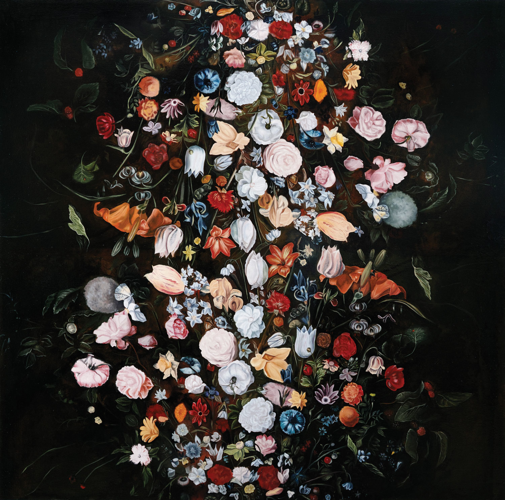


“Fiori 1,” Rocky Horton
When Andy Warhol reproduced a grainy photograph of Da Vinci’s Mona Lisa in a series of seven colored canvases in 1963, it was considered radical. But it opened the door for an examination of the relationship between high art and consumer culture, and called into question what was really important about paintings: the process of their creation or the end result. Warhol’s hybrids of the sacred and the profane might be the furthest thing from your mind when you see two recent paintings by Nashville-based artist Rocky Horton that are currently on view at David Lusk Gallery, but the artist’s focus on process continues the conversation that Warhol started, even as he reverses it.
“It would’ve been easy to create these images in Photoshop and printed, even on canvas,” Horton tells the Scene, explaining how the labor that went into making “Fiori 1” and “Fiori 2” is the conceptual heart of the work. “The decision to paint them is taken like a vow to consider the overt, borderline-silly romance of the image as serious and worthwhile.”

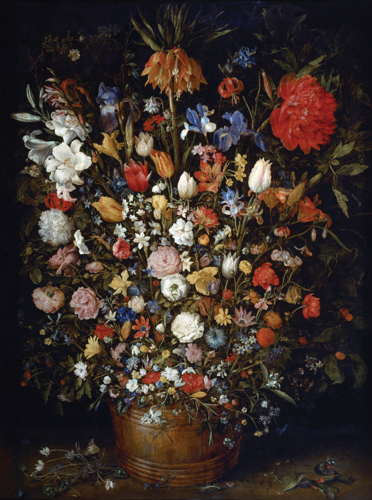
“Flowers in a Wooden Vessel,” Jan Brueghel the Elder, 1603
The paintings Horton uses as subject matter are 17th-century still lifes by Flemish master Jan Brueghel the Elder. Brueghel, the first artist to paint what is now called “pure flower still lifes,” was himself groundbreaking, since previous artists had always painted flowers as ornamental elements. Horton saw the works while on vacation in 2009 and began planning these paintings then.
“I love his painting, and wanted to create a kind of homage to this particular work,” Horton says. “I am not the painter that Brueghel is. So to try to be in concert with it somehow, I increased the scale and collaged the work into an explosive arrangement. This creates a kind of absurd floral still life turned firework display.”
The paintings’ black background has the sleek, high-gloss finish of a grand piano, and the assemblage of flowers is more kaleidoscopic than Brueghel’s. It’s as if those floral arrangements have been fed through a program that creates fractals out of everyday objects. But Horton’s goal isn’t to reproduce the painting exactly — it’s to show his very personal devotion to the subject matter, which is art history itself. Like Warhol commenting on the supremacy of the artwork as a product in itself, Horton pores over the Brueghel paintings — not the flowers.



Post a comment as anonymous
Report
Watch this discussion.
(0) comments
Welcome to the discussion.
Log In
Welcome to the discussion.
Keep it clean. Please avoid obscene, vulgar, lewd, racist or otherwise abusive language. Comments featuring hate speech or threatening or violent content will not be tolerated.
PLEASE TURN OFF YOUR CAPS LOCK.
Be truthful. Don't knowingly lie or mislead.
Be proactive. Use the “report” link on any comment that violates our comment policy.
Share with us. We'd love to hear your feedback.