
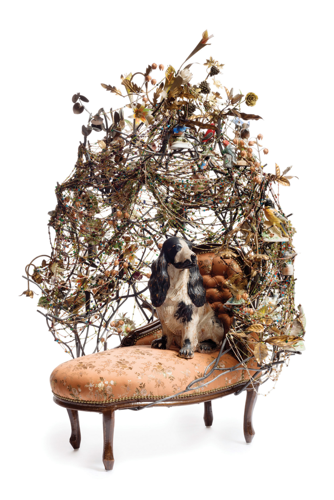
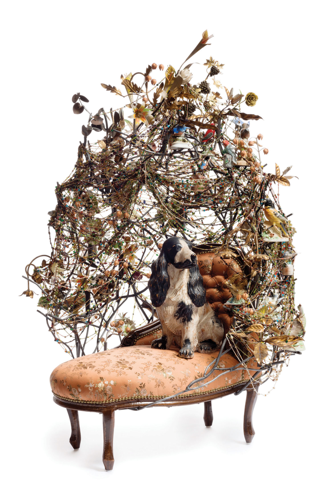


“Rescue,” Nick Cave
Nick Cave’s Magnificent Sculptures Come With Strings — and Twigs and Sequins — Attached
Frist Center patrons will remember Nick Cave’s “Soundsuit” sculptures from 2013’s 30 Americans — the otherworldly wearable fabric sculptures were a highlight of the show. This fall, the Frist will host Nick Cave: Feat., a solo exhibition presenting a selection of the Soundsuits along with a video projection, a number of wall sculptures, and a large multimedia installation. One of the most compelling qualities of Cave’s work is the way the colorful, outrageous pieces engage audiences of all ages while simultaneously offering complex, sophisticated statements that speak to issues of race and social justice.
The show’s 10 Soundsuits were made between 2011 and 2017, and will be dramatically deployed across a runway-style platform installation. The suits are Cave’s signature works, so look for this display to be highlighted at the exhibition. Cave’s original Soundsuit was created in the 1990s as a response to the infamous footage of Rodney King being beaten by Los Angeles Police Department officers — the wearable sculptures are metaphorical suits of armor, protecting black men from racial profiling and police brutality. Cave’s original suit was a modest affair — a rustling sheath of twigs that covered the wearer. The artist has gone on to create approximately 500 suits over the past two-and-a-half decades, in the process evolving them into the decorous, decadent duds viewers will see at the Frist this fall.
In addition to a gallery wrapped in twinkling fabric and an installation of thousands of suspended strands of colorfully patterned bamboo titled “The Architectural Forest,” Feat. will also include an immersive life-size video that will dominate one of the exhibition spaces. “Blot” is one of those time-based works that acts as both a work of art and a documentation of a performance. “Blot” features a whirling dancer decked out in one of Cave’s wild, wooly works. The costume and the performance combine to create abstract inky shapes moving through otherwise empty space for a little more than 40 minutes. The effect is immersive and hypnotic — and also points to the real-life performances that will be featured throughout the Frist’s Nick Cave program.
One of the most eagerly awaited elements of the exhibition’s time in Nashville will be Cave himself. In conjunction with Feat., Cave will direct a months-long community-engagement project that will culminate in free public performances featuring live dance, music, Soundsuits, spoken-word events and more. The artist’s original compositions will showcase performing arts organizations and university students from all over Middle Tennessee, while specifically engaging our city’s increasingly diverse population. One performance will include community bead-a-thon events where Nashvillians will create 30 decorative blankets, which will eventually be used to cover Cave’s body in a kind of scapegoat performance that will find the artist symbolically taking on the burdens and responsibilities we’re all weighed down by in our individual lives. JOE NOLAN
Through Oct. 13: Monuments and Structures at Belmont University
Featuring contributions by some of the most noted names in Nashville’s art scene, Monuments and Structures presents a timely display that deploys abstract paintings and photography in an examination of landmarks, urban reference points and figurative political monuments. The show at Belmont’s Leu Art Gallery includes work by Brady Haston, Tom Williams and Robin Paris. JOE NOLAN
Oct. 4-29: Eyes Like Enemies at East Side Project Space
Artist and curator Jodi Hays’ garage gallery, Dadu, is the most unique art space in East Nashville. This fall Hays will make a trip over the Shelby Street Bridge to host Eyes Like Enemies at the East Side Project Space in The Packing Plant. The two-person exhibition features work by Mark Brosseau and Brian Edmonds, who both explore the roles that space, memory and history play in our perceptions of painting. Hays will also have her own solo exhibition at Red Arrow in November. JOE NOLAN
Oct. 5-Nov. 9: Paul Harmon at Dane Carder Studio
Nashville’s visual art scene was still in its infancy in the 1990s, but Paul Harmon was on his way to having his pop-inspired paintings collected by patrons like Princess Caroline of Monaco. You could even make the argument that Harmon himself was Middle Tennessee’s art scene, so his exhibition at Dane Carder Studio promises to feel like a summit between the new kids and the old master. JOE NOLAN
Oct. 6-Jan. 21: World War I and American Art at the Frist
There’s a subtle but unmistakable difference between art history and art that’s of history. This exhibit at the Frist explores the way American art and artists contributed to the culture of World War I, placing it firmly in the latter camp, where art doesn’t just reflect the culture — it creates it. Featuring works by John Singer Sargent, Georgia O’Keeffe and George Bellows alongside propaganda posters and political cartoons, World War I and American Art explores work by more than 70 artists exploring wartime themes. Of special interest is the programming here, which includes a lecture by Richard Ormond, former deputy director of London’s National Portrait Gallery and great-nephew of John Singer Sargent, titled “Mr. Sargent Goes to War.” LAURA HUTSON
Oct. 6 to March: World War I and the Great Migration at Fisk University
A companion exhibition to the Frist’s World War I and American Art, Fisk University’s World War I and the Great Migration examines how the Great War spurred the relocating of 6 million African-Americans from the rural South to the urban centers of the industrial North between 1916 and 1970. The exhibition includes work from movements like the Harlem Renaissance and the Chicago Renaissance, and will feature work by Romare Bearden, Jacob Lawrence, Albert E. Smith and more. JOE NOLAN
Oct. 7-Nov. 24: Wailing Wall at The Browsing Room Gallery
Michael Dickins is the gallery director at Austin Peay, and Wailing Wall is the installation artist’s response to Trump’s proposed border wall. The work will ask viewers to reflect on their personal empathy — or apathy — toward those who will be most affected by such a separating structure. JOE NOLAN
Oct. 10-Nov. 11: Mark Bradley-Shoup and Wolf Kahn at David Lusk Gallery
Mark Bradley-Shoup’s abstract studies of architectural spaces feature exacting brushwork in scenes permeated with Zen stillness. Wolf Kahn’s paintings are also noted for their sense of stillness, but the artist’s preoccupation with natural landscapes makes his work a perfect complement to Bradley-Shoup’s. JOE NOLAN

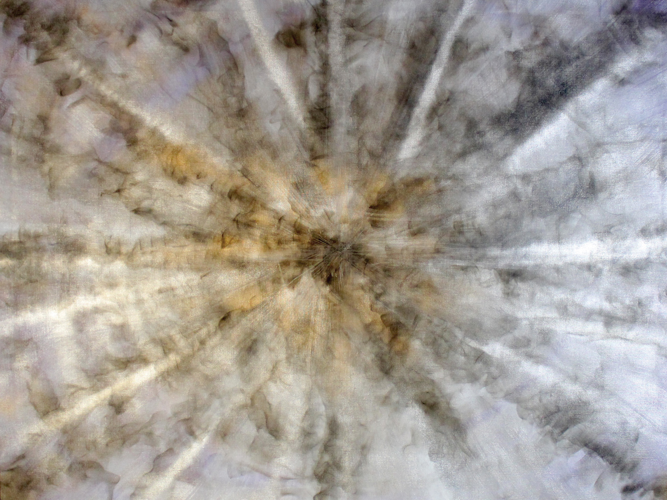
“I Hear Angels,” Tara Walters
Oct. 13-Nov. 5: Tara Walters — I Am Listening at The Red Arrow Gallery
Tara Walters uses a fumage technique to burn candle smoke into wet paint, creating ghostly patterns evoking portals that draw viewers into her picture planes. I Am Listening will also include a new video installation titled “TIME.” JOE NOLAN
Oct. 13-Nov. 18: John Warren at Seed Space
John Warren is among the city’s best video artists and experimental filmmakers. He’s also a Tennessee Arts Commission 2017 Individual Artist Fellow, and he used the stipend he received to fund 16 mm short films like “Honky Tonky,” a poetic study of Lower Broadway that premiered at the Nashville Film Festival in April. Warren’s study of downtown construction cranes, “Future Tense,” will screen at Seed Space this fall. JOE NOLAN
Nov. 11-Dec. 23: The Professors at Cumberland Gallery
For many artists, personal creativity and education go hand in hand. The Professors will feature work from leading Middle Tennessee educators who also maintain productive studio practices. The show will include work from Cheryl Goldsleger, David Kroll, Leonard Koscianski, Terry Thacker and David Lefkowitz. JOE NOLAN



